Weight management is a delicate subject which has cultural, gender, and age biases,
which are deeply rooted in society. Recently, in our attempt to balance some of these
negative body messages, as a society we are moving towards a more realistic inclusive
definition of healthy weight.
However, weight gain can be a warning sign of underlying metabolic and/or hormonal
imbalances which could also pose a serious health risk. This article looks at naturopathic
approaches to assessment, diagnosis, and management of underlying metabolic and
hormonal conditions which can lead to unhealthy weight, and provides some tips and
tools for healthy weight management.
Your Thyroid and Metabolism
Your thyroid is responsible for the calories you burn at rest, also known as your basal
metabolic rate (BMR). It is like a background program that is constantly running. The
impact of it reaches every single organ and cell in your body.
Low body temperature syndrome is a metabolic condition which negatively affects
your metabolism. It is:
- A persistent but reversible slowing of the metabolism;
- Often brought on by the stress of illness, injury, or emotional trauma;
- Often worsened in stages with subsequent stress episodes;
- The cause of low body temperature and associated low-thyroid (hypothyroid)
symptoms;
- A feeling that “something is wrong” which often doesn’t respond well to
improved rest, diet, exercise, or stress management alone;
- A condition which often shows normal thyroid hormone levels in blood tests;
- Often reversed with a special thyroid treatment; and
- Often associated with other chronic illnesses and or toxicity.
Predisposing Factors
Low body temperature syndrome is common for those whose ancestors survived
famine, such as:
- Irish, Scot, Welsh, American Indian, Russian, etc. Most susceptible of all seem to be
those who are part Irish and part American Indian.
- Under multiple or severe circumstances, people of any nationality can develop low
body temperature syndrome.
- About 80% of Wilson’s Temperature Syndrome sufferers are women.
For people who are more prone to developing WTS than others, their symptoms tend to:
- Come on earlier in life; so early that some patients may not even know what it feels
like to be normal;
- Worsen gradually over time, if left untreated; and
- Fail to respond to various therapies without much improvement, including
medication (thyroid hormone, antidepressants, mood stabilizers, etc.).
Common Symptoms of Low Thyroid Function (WTS)
- Weight gain, gradual increase over time despite eating well and exercise;
- Dry skin and/or hair loss unresponsive to most treatments;
- Feeling tired / difficulty waking up or waking up unrefreshed;
- Depression/anxiety;
- Constipation;
- Elevated cholesterol;
- Premature ageing;
- Low libido; and
- Fertility issues / difficulty conceiving.
How Can Low Body Temperature Cause
So Many Symptoms?
Enzymes are special proteins which spark chemical reactions in the body. All metabolic
actions that take place in our bodies are activated by enzymes. Enzymes depend upon
their shape for their function. When enzymes are not the right shape, they cannot
function optimally, resulting in mismanagement of the body’s entire metabolic system.
Factors Affecting Enzyme Function
- Body temperature;
- pH (how acid or alkaline body fluids are);
- Mineral levels (catalyst for enzyme reactions and buffers
for detox pathways); and
- Cellular toxicity (metabolic waste accumulation).
When the body temperature is too low, nearly all the enzymes in the body function
less effectively. This can cause a very wide variety of complaints.
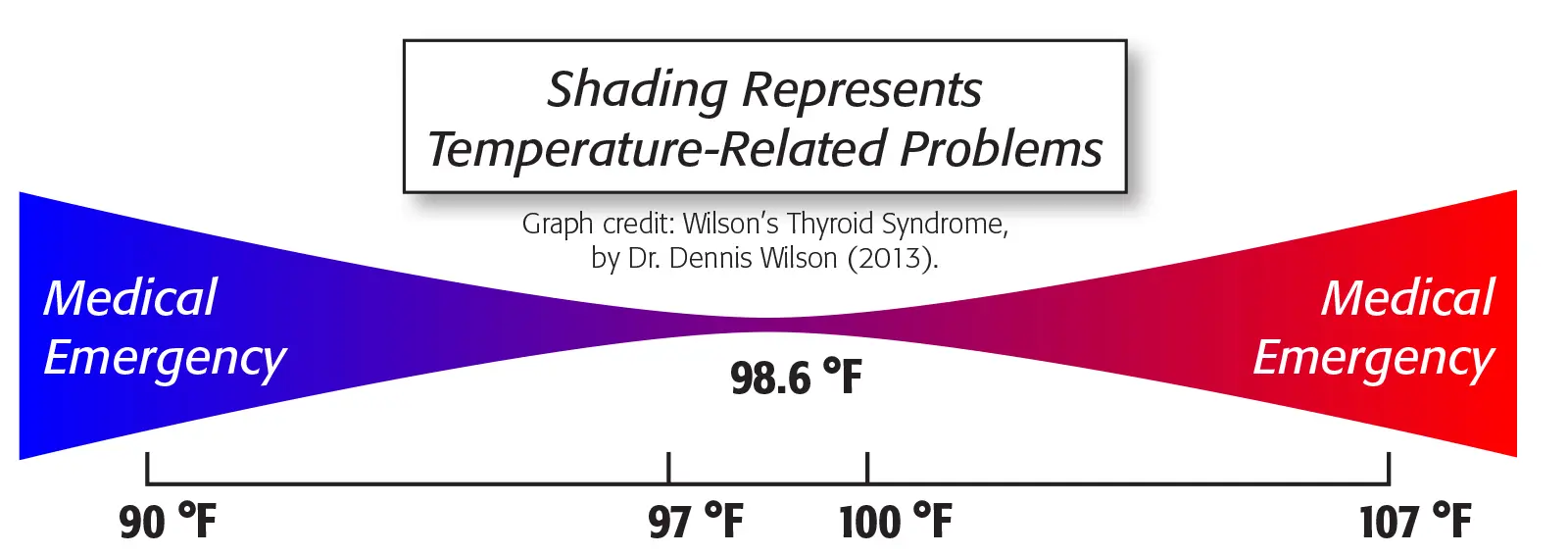
Photo credit: Wilson’s Thyroid Syndrome, by Dr. Dennis Wilson (2013).
High fevers (42 °C / 107 °F) can cause brain damage and even death, and very low
body temperatures (< 32 °C»/ 90 °F) can also be life-threatening.
 Likewise, a temperature a little above normal (say 38 °C / 100 °F) is plenty
of reason to feel badly and be
excused from school or work. Temperatures that are just below
37 °C / 98.6 °F can easily explain a classic set of symptoms. To function optimally, the body must be at the
optimal temperature: As close to
37 °C / 98.6 °F as possible.
To test this, the most accurate way is to take your temperature every three hours after waking, three times a day, to record your metabolic cycle. This is more accurate than
lab tests alone.
Hormone Imbalances Related to Weight
Gain and Low Body Temperature Syndrome
In my 15 years of treating low temperature syndrome, I have seen cases where
hormones play an important role in weight management. Adrenal function and
high cortisol, insulin, and blood sugar levels; estrogen dominance; menopause;
liver function; and medication use, when out of balance, have an impact on a
person’s ability to maintain healthy weight.
Adrenal Hypofunction
Low adrenal function has four phases which show distinct hormonal pictures.
Research done on medical students subjected to prolonged stress of medical
school show an initial phase of elevated adrenaline (acute phase) followed by
elevated cortisol (three months of stress) followed by a gradual decline, first in
adrenaline, then in both adrenaline and cortisol (six to nine months).
 High cortisol levels in the blood
(phase 2) slows metabolism by
altering thyroid function. Cortisol
blocks the conversion of thyroid
hormone (T4) to active thyroid
hormone (T3) and favours the
creation of reverse T3 (rT3).
This induces low body
temperature syndrome. High
rT3 levels are seen on blood
tests in patients with low
body temperature.
Impact on weight: High cortisol levels are corelated with midtruncal obesity or
“apple-shaped” fat distribution, which is associated with cardiovascular and
diabetes risk in men and women.
Insulin Dysregulation: Reactive Hypoglycemia and Prediabetes
Insulin is a hormone produced by the pancreas in response to the food you eat.
Think of insulin like an all-season entry pass for sugar to enter the cells of the
body from the blood. Once inside cells, sugar is used as fuel. But that is only
half the picture. Your pancreas will provide an extra 50% background insulin
and leave it in your bloodstream as backup to ensure your cells have a constant
supply of glucose or fuel.
If blood sugar levels drop because too much insulin is produced or too little
blood sugar is available, then hypoglycemia or low blood sugar can result.
What some people feel when they miss a meal and get “hangry” (hungry and
angry). Low blood sugar is a serious condition which can cause the body to
go into shock or lose consciousness. Hypoglycemic events can be triggered
by exertion, stress, medication, liver issues, not eating enough food, and
mineral depletion which I have clinically seen in oral contraceptive use (zinc
and chromium depletion).
Impact on weight: Excess or irregular spikes in insulin levels can cause
midtruncal weight gain and fat deposits along the waist, increasing the risk of
heart disease and diabetes.
Estrogen Dominance
Hormone imbalances can occur at nearly any age. The normal pathway for
estrogen production starts with compounds called acetates. Acetates convert
to progesterone, which then forms estrogens. Progesterone also antagonizes
(opposes) estrogen function to help maintain proper hormone balance. When
estrogen takes this pathway, a woman is progesterone-dominant, and the
hormones are in proper balance. The alternate pathway for estrogen production
is from acetates to the adrenal hormone DHEA, then to estrogen. In this case,
production of enough progesterone is bypassed, creating a condition known as
estrogen dominance.
Symptoms of estrogen dominance include endometriosis, fibroids, ovarian cysts,
weight gain, thyroid suppression, depression, lack of libido, insomnia, and an
increase of facial hair from the excess testosterone formed from the unopposed
estrogen. External hormone sources—such as birth control pills, estrogen
replacement therapy, estrogens found in farm-raised meats, and xenoestrogens
(dioxins, DDT, PCBs, etc.)— can aggravate these problems.
Impact on weight: Excess estrogen causes fatty deposits all over the body,
resulting in general weight gain, which responds well to hormone management
by improving liver function and eliminating excess estrogens.
 Angeli Chitale, ND
Dr. Angeli Chitale is a licensed naturopathic doctor
with additional training and certification in treatment
of both thyroid and endocrine conditions including
fertility for men and women.
www.restorativemedicine.ca


 English